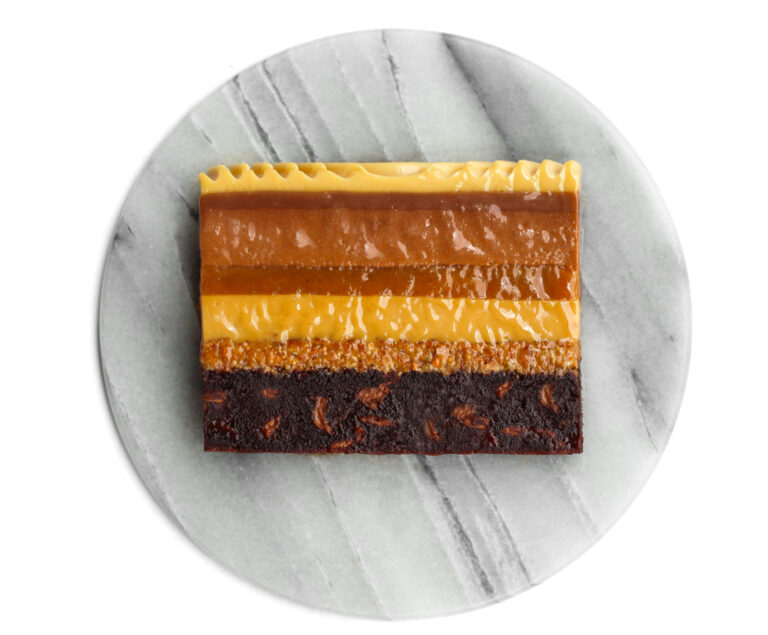
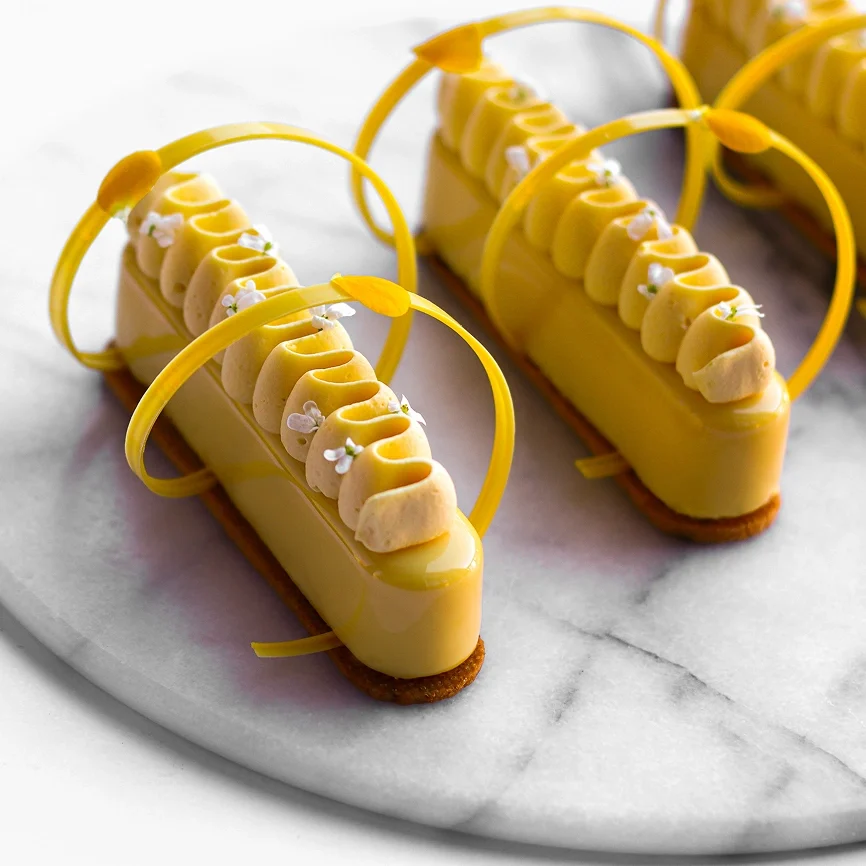
Paired with rich chocolate and toasted hazelnuts, the blueberries really shine. With a fudgy brownie, crisp hazelnut crunch, velvety blueberry crémeux, and a light blueberry mousse, this cake is just as delicious as it is beautiful.
Plus, lilacs are among my favorite flowers to decorate cakes with, and blueberries create one of the most beautiful natural colors in pastry. Together, they make for a stunning combination that’s full of soft spring shades.
Happy baking <


Brownie Base:
- 125 g dark chocolate (54%)
- 125 g butter
- 125 g caster sugar
- 150 g eggs (approx. 3 medium eggs)
- 5 g all-purpose flour
- 80 g milk chocolate (33%)
- Coarsely chop the chocolate.
- Slowly melt the butter in a saucepan (it shouldn’t be too hot, as this can cause the chocolate to separate later). Add the chocolate over low heat. Stir until all the chocolate has melted.
- Remove the saucepan from the heat and stir in the sugar. Lightly beat the eggs with a fork in a separate bowl.
- Let the batter cool slightly, then gradually add the eggs while whisking with a hand whisk. Finally, fold in the flour and chopped milk chocolate.
- Pour the batter into a lined 20-cm cake ring or springform pan.
- Bake the base at 180°C / 356°F for about 20–23 minutes. It should be soft in the center and feel slightly underbaked.
- Let the base cool completely. Cut out the center of the brownie using a 14 cm cake ring, leaving a 3 cm border around the edge.
- Place the brownie in a clean cake ring (20 cm in diameter) lined with an acetate sheet on the inside and parchment paper on the bottom, with a smaller cake ring (14 cm in diameter), lined with an acetate sheet, in the center.
- Refrigerate the cake until you’re ready to add the hazelnut crunch.
Tips & Notes:
- If baking with pastry rings, use two rings of different sizes and place a piece of baking paper in between to keep the batter contained.
Hazelnut Crunch with Nutella:
- 60 g shelled hazelnuts
- 90 g caster sugar
- 25 g dark chocolate (54%)
- 25 g milk chocolate (33%)
- 2 tbsp Nutella
- Toast the hazelnuts for 5–7 minutes at 175°C / 347°F.
- Gently melt the sugar into a golden caramel in a saucepan, stir in the nuts, and pour the mixture onto a sheet of parchment paper. Let the nuts cool.
- Place 2/3 of the nuts in a powerful mini food processor and blend them into praline. Finely chop the remaining nuts.
- Gently melt the chocolate (if necessary, in a double boiler) and then the Nutella. Set the bowl aside.
- Stir the praline and the finely chopped nuts into the chocolate Nutella mixture.
- Put the hazelnut crunch mixture into a piping bag and spread it over the base. Smooth the surface with a small palette knife.
- Place the cake in the freezer so it can set completely.
Tips & Notes:
- Don’t chop the nuts too finely, as this will reduce the crunch effect.
- Level the surface with a glass or a spoon.
Blueberry Crémeux:
- 0.5 gelatin sheets (1 sheet = 1.75 g, bloom value 240)
- 185 g white chocolate (28%)
- 50 g egg yolks (approx. 2.5 medium egg yolks)
- 15 g caster sugar
- 90 g blueberry purée (made from approx. 250 g blueberries)
- 30 ml lemon juice (approx. 2 tbsp)
- 100 ml heavy cream (min. 35%)
- Bring the blueberries to a boil in a saucepan until the berries are tender. Strain the mixture and set the purée aside. You will need 130 grams of blueberry purée.
- Soak the gelatin sheets in cold water for 5–10 minutes.
- Gently melt the chocolate (if necessary, over a double boiler) and set it aside in a bowl.
- Quickly whisk the egg yolks and sugar together in another bowl.
- Heat the heavy cream, blueberry purée, and lemon juice to a boil in a small saucepan. When the mixture reaches a boil, pour it over the egg yolk and sugar mixture while whisking briefly.
- Pour the mixture back into the saucepan and gently heat it to 83°C / 181°F. Remove the saucepan from the heat.
- Strain the mixture and fold in the gelatin.
- Pour the hot mixture over the chocolate while stirring in the center with a spatula until it comes together.
- Then blend the crémeux in a tall pitcher (this prevents too many air bubbles).
- Pour the crémeux into the insert of a Kit Symphony silicone mold, filling it halfway.
- Place the mold in the freezer overnight.
Blueberry Mousse:
- 3 gelatin sheets (1 sheet = 1.75 g, bloom value 240)
- 400 g white chocolate (28%)
- 300 g fresh blueberries
- 60 ml lemon juice
- 40 ml heavy cream (min. 35%)
- 2 tsp vanilla paste
- 400 ml heavy cream (min. 35%)
- Cook the blueberries in a saucepan until tender. Strain the mixture and set the purée aside.
- Soak the gelatin sheets in cold water for 5–10 minutes.
- Gently melt the chocolate (if necessary, over a double boiler) and set it aside in a bowl.
- Bring the blueberry purée, heavy cream (40 ml), and lemon juice to a boil in a small saucepan. Remove the saucepan from the heat, strain it, and whisk in the gelatin.
- Pour the hot mixture over the chocolate while stirring in the center with a spatula until it comes together.
- Let the mixture cool until lukewarm.
- Whip the heavy cream (400 ml) to soft peaks and fold it into the mixture, which has cooled to lukewarm (if it’s too hot, it may curdle the heavy cream).
- Fill a piping bag with the mousse and pipe it into a Kit Symphony silicone mold, filling the mold halfway.
- Place the frozen blueberry crémeux insert into the mousse, followed by the brownie and crunch layer, with the brownie facing upward and the crunch layer facing downward.
- Pipe or spread the remaining mousse around the insert and brownie layer until the mold is completely filled.
- Place the cake in the freezer overnight.
Tips & Notes:
- Let the fruit syrup cool completely, as syrup that’s too hot will seize the whipped cream when added.
- Whip the heavy cream to soft peaks, as overwhipped cream can result in a dense and grainy mousse.
Chocolate Mousse Domes:
- 0.5 gelatin sheets (1 sheet = 1.75 g, bloom value 240)
- 70 g milk chocolate (33%)
- 100 ml heavy cream (min. 35%) (30 ml warmed, 70 ml whipped)
- Soak the gelatin sheets in cold water for 5–10 minutes.
- Gently melt the chocolate (if necessary, over a double boiler) and set it aside in a bowl.
- Heat 30 ml of heavy cream to a boil. Remove the saucepan from the heat and whisk in the gelatin.
- Pour the hot heavy cream over the chocolate while stirring in the center with a spatula until it comes together. Let the mixture cool to lukewarm.
- Whip 100 ml of heavy cream to soft peaks and fold it into the mixture that has cooled to lukewarm (if it’s too hot, it may cause the heavy cream to separate).
- Pour the chocolate mousse into a mousse dome silicone mold (2.5 cm in diameter).
- Place the domes in the freezer overnight.
Tips & Notes:
- Only heat the cream almost to a boil before pouring it over the chocolate to avoid seizing the chocolate.
- Whip the heavy cream to soft peaks, as overwhipped cream can result in a dense and grainy mousse.
Glaze:
- 3 gelatin sheets (5.25 g, bloom value 240)
- 75 g white chocolate (28%)
- 55 ml heavy cream (min. 35%)
- 25 g water
- 70 g caster sugar
- 75 g glucose syrup
- purple powdered food coloring
- Soak the gelatin sheets in cold water for 5–10 minutes.
- Finely chop the white chocolate and place it in a large pitcher.
- Heat the sugar, water, heavy cream, and glucose syrup to a boil. Remove the pot from the heat and whisk in the gelatin.
- Pour the hot mixture over the chocolate in the pitcher. Blend with an immersion blender until the glaze comes together (hold the blender at an angle to avoid air bubbles). Add a little purple food coloring.
- Cover the top of the glaze with plastic wrap and let it cool to 34-35°C / 93-95°F.
- Remove the frozen domes from the freezer just before glazing. Place the mousse domes on a rack lined with parchment paper.
- Pour the glaze over the domes. Use a small palette knife to run along the bottom of the domes on the rack to remove any glaze strands.
- Immediately place the domes on the cake.
Tips & Notes:
- Let the hot syrup set for 30 seconds so the chocolate can melt a bit.
- Insert the immersion blender in the jug at an angle to prevent creating air bubbles.
- The cake needs to be completely frozen when the glaze is poured on. If the correct temperatures have been met, you’ll get a perfectly shiny mirror glaze.
Decoration:
- lilacs (the flower petals are safe to eat)
- fresh blueberries (extra, for garnish)
- Place the cake on a cake platter and let it thaw in the refrigerator for at least 6 hours.
- Garnish the cake with lilacs in various colors and fresh blueberries.